Table of Content
Infant Food Regulations in India: FSSAI Standards and Approval Process
A clear guide to Infant Food regulation India — covering FSSAI Infant formula standards, labelling, contaminants, and the baby food approval India process.
Feeding infants safely starts with strict regulatory oversight. Infant food regulation in India places nutrition products under some of the tightest scrutiny in the food sector.
This article outlines FSSAI infant formula standards, the labelling and safety testing requirements for baby food approval in India, and the broader compliance framework manufacturers must follow.
Understanding Infant Food Regulation India
Foods for Infant nutrition must meet strict age, texture, and taste requirements before they can be manufactured or sold in India.
- Infant formula is designed for infants up to 6 months old.
- Follow-up formula targets infants aged 6 to 24 months and forms the liquid part of their diet.
- The product’s texture must stay smooth, uniform, and completely free from lumps.
- Taste must be free from musty odour or rancid notes, matching Infant taste preferences.
- Ingredients should be based on cow, buffalo, or other milch animal milk, blended with permitted nutrients.
FSSAI Infant Formula Standards for Labelling
Labels carry critical information for parents and caregivers, so FSSAI Infant formula standards set out precise, mandatory declarations.
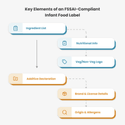
Labels must comply with both the Foods for Infant Nutrition Regulations and the Labelling and Display Regulations, 2020. Key labelling requirements include:
- Ingredient list in descending order of quantity
- Nutritional components covering vitamins, minerals, and energy content
- Vegetarian or non-vegetarian indication using the required logo
- Food additive declarations using specific names and class titles
- Brand owner details, FSSAI logo and license number, net quantity, and manufacture/expiry dates
- Country of origin and allergen declarations
Figure 1: Key Elements of an FSSAI-Compliant Infant Food Label

Baby Food Approval India: Safety and Contaminant Limits
Baby food approval India grants hinge heavily on microbiological safety and strict contaminant thresholds, given how sensitive infants are to exposure.
Microbiological standards require aerobic plate counts within safe limits, complete absence of coliforms and E. coli, and freedom from Salmonella and Listeria. Infant formula must also be tested for Enterobacteriaceae.
Table 1: Maximum Permissible Contaminant Levels in Infant Food
| Contaminant | Maximum Permissible Level |
| Lead | 0.02 mg/kg |
| Copper | 15 mg/kg (minimum 2.8 mg/kg) |
| Cadmium | 0.1 mg/kg |
| Arsenic | 0.05 mg/kg |
| Tin | 5 mg/kg |
Infant Nutrition Compliance: Advertising and Certification
Infant nutrition compliance extends well beyond the product itself, covering how it is marketed and which certifications back it up.
- No claim may suggest a product equals or exceeds mother’s milk in benefit.
- Every container must carry a clear, readable “important notice” section.
- Labels must state “mother’s milk is best for your baby” in capital letters.
- Products should be recommended for use only on a health worker’s advice.
- Marketing must follow the Infant Milk Substitutes, Feeding Bottles and Infant Foods Act, 1992.
Conclusion
- Infant food regulation India enforces sets strict age, texture, and ingredient rules for Infant and follow-up formula.
- FSSAI Infant formula standards require detailed labels covering ingredients, nutrition, additives, and allergens.
- Baby food approval India demands depends on meeting microbiological safety limits and strict heavy metal contaminant thresholds.
- Infant nutrition compliance includes truthful advertising, mandatory warning statements,
- Manufacturers must align with the IMS Act, 1992, alongside FSSAI’s Foods for Infant Nutrition Regulations, 2020.
- Adhering to every requirement protects Infant health while ensuring products stay market compliant.
Enquire Now
To enquire about our services please complete the form below and we will be in tough with you as soon as possible

Food Regulatory Services
- Consumer Product
- Compliance Services
- Licenses