Table of Content
Resveratrol, Spermidine: Can You Legally Sell Longevity Supplements in India — and What Does It Actually Take to Get There?
By Dr. Ashwini Kumar
Founder & CEO, CE Group of Companies | Forbes Business Council Member
Regulatory Affairs Expert | Clinical Trials Advisor | Medtech & Food Regulatory Consultant
The Global Longevity Boom Has Arrived at India’s Door
The longevity supplement market has moved from the fringes of biohacking culture to mainstream consumer health. Backed by high-profile researchers and a growing body of human clinical data, ingredients like trans-Resveratrol, Spermidine, and Fisetin now command premium price points and intensely loyal consumer bases in the United States, United Kingdom, Japan, and across Europe.
India’s regulatory environment has not kept pace with global longevity supplement market development. The result is a landscape that many foreign companies are approaching incorrectly — with assumptions drawn from their US or EU experience that do not hold in the Indian context.
As a physician, a regulatory affairs expert, and the founder of one of India’s largest healthcare Regulatory consulting firms, I want to give the global longevity industry a clear-eyed picture of what India’s Regulatory framework requires — and what a credible, legally compliant India market entry for these products looks like.
The First Question: Are These Products Even Legal in India?
The short answer is it depends on the ingredient, the formulation, and whether the right Regulatory approvals have been obtained.
India has not banned Resveratrol. India has not banned Spermidine or Fisetin. What India has done is build a Regulatory Framework — the FSS (Approval for Non-Specified Food and Food Ingredients) Regulations, 2017 — that requires mandatory prior approval from FSSAI’s headquarters before any food product or ingredient that falls outside existing standards and schedules can be manufactured, sold, or imported.
Most of the leading longevity supplement ingredients fall into this category. They are not listed in FSSAI’s current Health Supplements or Nutraceuticals schedules. They have no traditional history of use in India. And they have not previously gone through FSSAI’s scientific review process — with a few notable exceptions where early Indian supplement companies have navigated the approval pathway.
What this means in practice: a “foreign companies “who imports such supplements into India without prior FSSAI Non-Specified Food (NSF) approval is importing an unapproved food product. The consignment is liable to be held at port, rejected, and in some cases, the importer faces regulatory action.
The Regulatory Reality: Ingredient by Ingredient
| Ingredient | FDA (US) | EU Status | FSSAI India Status | India Pathway |
|---|---|---|---|---|
| NR (Nicotinamide Riboside) | Supplement — permitted | Authorized Novel Food (2017) — max 300mg/day adults | Not in FSSAI schedules. NSF approval required. | NSF — ₹50 Thousand INR fee, 12–24 months |
| Trans-Resveratrol | Supplement — permitted | Authorized Novel Food — max 150mg/day adults | No composite standard. | Classification audit required |
| Spermidine | Supplement — permitted | Authorized Novel Food (EU 2020/443) — wheat germ extract | Not in FSSAI schedules. NSF approval required. | NSF — ₹50 Thousand INR 12–24 months |
| Fisetin | Supplement — permitted | Supplement market — no specific Novel Food authorization | Not in FSSAI schedules. NSF approval required. | NSF— ₹50 Thousand INR 12–24 months |
| Quercetin | Supplement — permitted | Available as supplement; no specific authorization | Partially covered under nutraceutical schedules — review required | Classification audit required |
Table 1
The Claims Problem: Why Your Global Label Cannot Enter India Unchanged
FSSAI’s claims framework is significantly more conservative than both the FDA’s dietary supplement regime and the EU’s health claims register. Brands that attempt to bring their global label language directly into India — even after obtaining product approval — risk enforcement action and label recall.
The Market Opportunity: Why This Is Worth the Regulatory Investment
India’s Nutraceutical market is currently valued at approximately $8–10 billion and growing at 15–20% annually. The healthy aging and longevity segment, while nascent compared to markets like Japan or the United States, is expanding rapidly — driven by a growing urban professional class with disposable income, access to global health information, and increasing awareness of preventive health strategies.
Several early movers have already validated the commercial thesis.
For global foreign companies with established longevity supplement brands, India offers a compelling opportunity for three reasons: scale (1.4 billion consumers), growth trajectory (one of the world’s fastest expanding middle classes), and relatively low competition at the premium longevity tier — for now.
The Strategic India Entry Framework for Longevity foreign companies
Based on our regulatory consulting experience with global Nutraceutical and health supplement brands entering India, the framework that consistently produces the best outcomes is:
Phase 1 — Classification and Intelligence (Months 1–2)
Commission a product classification audit. Determine which ingredients require NSF approval and which can proceed under standard FSSAI licensing. Identify the fastest path to a commercially viable initial product range.
Phase 2 — Dossier Development (Months 2–5)
Begin dossier preparation for NSF applications. Commission any missing safety studies. Compile international Regulatory approvals, GRAS documentation, and consumption pattern data. Do not wait until all dossiers are complete before filing — file sequentially as each dossier reaches readiness.
Phase 3 — Regulatory Filing and Market Preparation (Months 4–8)
File NSF applications with FSSAI HQ. Simultaneously begin India label development, FFMF registration on the ReFoM portal, and India importer or authorised agent selection. Set up FICS prior intimation protocols.
Phase 4 — Parallel Market Development (Months 6–18)
While NSF approvals are under review, launch permissible products (CoQ10, Omega-3, standard vitamins and minerals) to build brand presence and distribution infrastructure. Use the period to develop e-commerce, retail, and practitioner channel relationships.
Phase 5 — Full Portfolio Launch (Month 18+)
As NSF approvals are received, introduce flagship longevity ingredients to the Indian market with compliant labelling and an established commercial infrastructure.

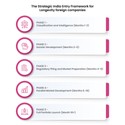
Figure1
A Final Note on FSSAI as a Partner
It would be a mistake to read this article and conclude that India’s Regulatory Framework is simply an obstacle to be overcome. FSSAI’s conservative approach to novel food ingredients is grounded in legitimate public health logic — India’s population includes enormous variation in nutritional status, access to healthcare, and ability to self-manage adverse effects. A regulator that approves novel ingredients carefully is protecting its citizens, not obstructing commerce.
The most successful global brands in India’s Nutraceutical space are those that approach FSSAI as a regulatory partner — investing in rigorous dossiers, responding promptly and completely to Scientific Panel queries, and building a track record of compliance that creates goodwill for future product approvals.
How CliniExperts Can Help
CliniExperts and Innovation Bridge Healthcare (IBH) are India’s most experienced integrated regulatory and commercialisation partner for global Nutraceutical and longevity supplement foreign companies Our services cover the complete India entry journey:
- Product and ingredient classification audit with written regulatory opinion
- NSF dossier preparation — safety data, CoA, GRAS documentation, consumption pattern modelling
- FSSAI HQ application filing and Scientific Panel query management
- India-compliant label development for longevity supplement categories
- FFMF / ReFoM registration and ongoing compliance management
- India entity setup, import licensing, and distribution strategy
- Market access intelligence — competitor landscape, pricing, channel strategy for Nutraceutical foreign companies
If you are a global longevity supplement brand evaluating India, the most important conversation you can have right now is about regulatory classification. We can help you have it.
Enquire Now
To enquire about our services please complete the form below and we will be in tough with you as soon as possible

Food Regulatory Services
- Consumer Product
- Compliance Services
- Licenses