Table of Content
When Does Your Product Need FSSAI Non-Specified Food Approval — and What Does the Process Really Look Like?
By Dr. Ashwini Kumar
Founder & CEO, CE Group of Companies | Forbes Business Council Member
Regulatory Affairs Expert | Clinical Trials Advisor | Medtech & Food Regulatory Consultant
The Question No One Asks Early Enough
Most global food and nutraceutical brands learn about India’s Non-Specified Food (NSF) approval requirement the hard way — when a consignment is held at port, or when a regulatory due diligence reveals that their flagship product contains an ingredient with no place on FSSAI’s permitted lists.
By that point, the conversation changes completely. Instead of discussing distribution strategy and commercial timelines, we are discussing a 12–24 month approval process, a ₹50,000 thousand non-refundable application fee, and a dossier that needs to be built from scratch.
The question every foreign company should ask — and almost none asks early enough — is this: Does my product require Non-Specified Food approval before it can enter the Indian market?
This article tells you exactly how to answer that question, and what happens next if the answer is yes.
When Does the NSF Trigger Apply?
Under the Food Safety and Standards (Approval for Non-Specified Food and Food Ingredients) Regulations, 2017, a product requires prior FSSAI approval if it falls outside both the standardised food category and the proprietary food category. In practical terms, the trigger scenarios are:
| Scenario | Pathway | Timeline |
|---|---|---|
| All ingredients FSSAI-permitted, no composite standard | Proprietary Food — standard FBO license | Weeks to months |
| Ingredient permitted globally (GRAS/EU) but not in FSSAI schedules | Non-Specified Food — NSF approval mandatory | 12–24 months |
| Ingredient derived from novel source (algae, fungi, biotech) | Non-Specified Food — NSF approval mandatory | 12–24 months |
| Novel food technology (e.g., UV treatment, enzyme modification) | Non-Specified Food — NSF approval mandatory | 12–24 months |
| Ingredient with no history of use in India | Non-Specified Food — NSF approval mandatory | 12–24 months |
| Product contains approved ingredients but one unapproved additive | Additive approval + potential NSF — case by case | Variable |
Table1
The decision tree is straightforward: start with FSSAI’s permitted ingredient schedules. If every ingredient in your product is listed and within permitted limits, you are likely looking at Proprietary Food. If even one ingredient falls outside those schedules — regardless of its approval status in the US, EU, or elsewhere — you are looking at the NSF pathway.
The ₹50 K Reality: What the Fee Tells You
“The application fee for Non-Specified Food (NSF) approval is ₹50,000 per product or ingredient (excluding GST), and payment must be made online at the time of submission through FSSAI’s ePAAS portal”. It is non-refundable under all circumstances — including rejection, withdrawal, or application closure.
This fee is deliberately significant. It signals that the NSF pathway is not a routine registration — it is a formal scientific safety evaluation. FSSAI convenes its Scientific Panels, reviews your safety data, and makes a risk-based determination about whether your product or ingredient can enter the Indian food supply.
The practical implication: you cannot afford to file an underprepared application. An application that is returned, queried extensively, or rejected wastes both the fee and the timeline. The investment in pre-filing due diligence and a properly assembled dossier is not optional — it is financial prudence.
The Complete NSF Approval Process
| Phase | Activity | What Happens | Timeline |
|---|---|---|---|
| 1 | Pre-filing due diligence | Regulatory classification, ingredient mapping, dossier gap analysis | 4–8 weeks |
| 2 | Dossier preparation | Safety data compilation, CoA generation, GRAS/CODEX documentation, draft label | 6–12 weeks |
| 3 | Application filing | Form I submission + ₹50,000 online payment on FSSAI’s ePAAS portal. | 1–2 weeks |
| 4 | Initial FSSAI review | Acknowledgement, completeness check, referral to Scientific Panel | 4–8 weeks |
| 5 | Scientific Panel review | Risk assessment, potential queries, additional data requests | 6–18 months |
| 6 | Approval / rejection | If approved: conditions of use issued; if rejected: review petition option | After Phase 5 |
| 7 | Post-approval compliance | Label finalisation, FFMF registration, import license, FICS setup | 4–8 weeks |
Table2
The Dossier: What FSSAI Actually Needs
The quality of your dossier is the single biggest determinant of your approval timeline. FSSAI’s Scientific Panels need sufficient evidence to conduct a credible risk assessment. The data package must include:
Safety Evidence
- Complete ingredient specifications — chemical identity, structure, purity, source
- Manufacturing process — how the ingredient or product is produced
- Toxicological data — genotoxicity, sub-chronic and chronic toxicity studies where available
- ADME data (absorption, distribution, metabolism, excretion) for novel ingredients
- Contaminant profile — heavy metals, pesticides, mycotoxins, microbiological parameters
Consumption History
- Which countries the product is approved and sold in, with regulatory authority references
- GRAS (Generally Recognized as Safe) status documentation if applicable
- WHO/FAO/CODEX listing references
- Evidence of consumption history in India or traditional use in the region of origin (if any)
- Estimated daily intake calculations for Indian consumption patterns
Product and Labelling
- Full product formulation — every ingredient, concentration, and additive
- Proposed India label — must comply with FSS (Labelling & Display) Regulations 2020
- Proposed conditions of use — dosage, target population, contraindications if any
- Analytical test reports — CoA from accredited laboratory covering all relevant parameters
For longevity and anti-aging supplements — NR, Spermidine, Fisetin, and similar ingredients — the dossier must be particularly robust. These ingredients have limited traditional use history in India, are not listed in FSSAI’s current schedules, and face a Scientific Panel that will scrutinise their evidence base carefully. The dossier for these categories needs to be built to the standard of a clinical safety submission, not a routine food ingredient notification.

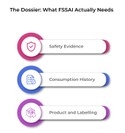
Figure1
The Scientific Panel: Where Applications Are Won and Lost
Once your application passes the initial completeness check, it is referred to FSSAI’s Scientific Panel for risk assessment. The Panel may include subject matter experts drawn from academia, government research institutes, and clinical medicine — depending on the ingredient category.
The Panel may issue one or more rounds of queries. These are requests for additional data, clarification on safety studies, or supplementary information on consumption patterns or manufacturing processes. Your ability to respond to Panel queries quickly, completely, and with high-quality data is what separates a 12-month approval from a 24-month one.
Applications that do not respond within stipulated timeframes may be closed or moved to lower priority. Applications with incomplete responses generate further queries. This iterative loop is the primary driver of extended timelines — and it is entirely within the applicant’s control to manage.
A note on rejections: FSSAI’s published status list as of May 2025 runs to 61 pages and includes a significant proportion of applications in ‘closed’, ‘withdrawn’, or ‘under process’ status. Rejection is not uncommon — particularly for applications where the safety evidence is insufficient or the ingredient has no credible international approval history. A review petition is available post-rejection, but it does not return your fee and restarts the timeline.
Common Reasons Applications Are Delayed or Rejected
- Incomplete dossier at filing — missing toxicological data, incomplete CoAs, no consumption history documentation
- GRAS or international approval cited but not documented — citations are not sufficient; full documentation is required
- Indian consumption pattern calculations missing or unrealistic
- Proposed label contains impermissible claims — ‘anti-aging’, ‘cellular repair’, ‘boosts immunity’ without substantiation
- Manufacturing process description insufficient for Panel to assess safety risk
- No response or delayed response to Panel queries
- Application filed for wrong category — ingredient should have been assessed as novel food under separate pathway
Strategic Implications for Foreign Companies
The NSF pathway is not a barrier to the Indian market — it is a structured process that, when navigated correctly, results in a defensible, legally compliant product approval. India is one of the world’s largest and fastest-growing markets for nutraceuticals and functional foods. The regulatory investment is proportionate to the commercial opportunity.
The brands that succeed are those that treat the NSF process as a project, not a formality. They begin ingredient classification 18 months before their target market entry date. They commission the right safety studies in advance. They work with regulatory partners who know how to build the dossier and manage the Panel process.
The brands that fail are those that assume their US or EU approval confers India market access, or that India’s regulatory requirements are less demanding than Western markets. In the nutraceutical category specifically, India’s FSSAI has become a rigorous and methodical regulator — and a correctly navigated NSF approval is a meaningful competitive asset.
How CliniExperts Can Help
CliniExperts has built one of India’s deepest regulatory consulting practices in the food and nutraceutical space. Our NSF services include:
- Product and ingredient classification audit — definitive assessment of Proprietary Food vs NSF trigger
- Pre-filing dossier gap analysis — identify exactly what data you have.
- Full dossier preparation — safety data compilation, CoA coordination, GRAS/CODEX documentation, consumption pattern modelling
- FSSAI HQ application filing and correspondence management
- Scientific Panel query response — rapid, high-quality responses to Panel requests
- India-compliant label development to satisfy FSSAI approval conditions
- Post-approval import setup — FFMF registration, Central License, FICS management
If you are evaluating a product for India entry and want to know whether the NSF pathway applies to you, the right starting point is a classification audit. We can typically provide a written regulatory opinion within 5–7 working days.
Enquire Now
To enquire about our services please complete the form below and we will be in tough with you as soon as possible

Food Regulatory Services
- Consumer Product
- Compliance Services
- Licenses