Table of Content
Compliance Checklist for Overseas Food Manufacturers Exporting to India
A practical guide to Foreign Food Manufacturing Registration, ReFoM norms, and FSSAI Import rules every overseas exporter must follow before shipping food products to India.
India is one of the fastest-growing food Import markets in the world. However, before any shipment reaches Indian ports, exporters must complete Foreign Food Manufacturing Registration and satisfy FSSAI’s compliance framework in full.
Food Export Compliance India: What Overseas Manufacturers Must Know
Food Export compliance India begins at the source — the manufacturing facility abroad. FSSAI requires overseas plants to meet hygiene, labelling, and traceability standards equivalent to domestic norms.
Manufacturers must also nominate an Indian authorized agent or importer who will manage documentation, customs clearance, and communication with FSSAI on their behalf throughout the process.
Compliance is not a one-time formality. Overseas facilities must maintain ongoing records, respond to periodic FSSAI communication, and update product or facility details whenever significant changes occur at the manufacturing site.
Non-compliance can result in shipment detention, product recalls, or blacklisting of the manufacturing facility, making early and accurate registration essential rather than optional for long-term market access.
Food Import Regulations India Governing Foreign Suppliers
Food Import regulations India is primarily governed by the FSSAI (Import) Regulations, 2017, along with periodic notifications covering high-risk food categories such as dairy, meat, and infant nutrition products.
Key regulatory requirements include:
- Valid FSSAI Import license for the Indian importer
- Compliance with Food Safety and Standards Act labelling rules
- Product conformity with Indian permissible additive and contaminant limits
- Health/sanitary certificates from the exporting country’s competent authority
- Port-of-entry inspection and sampling clearance by authorized labs
These regulations apply across categories such as dairy products, meat and poultry, fish and seafood, infant food, nutraceuticals, and packaged processed foods entering Indian markets.
FSSAI periodically revises the list of notified categories requiring stricter scrutiny. Overseas manufacturers should track official notifications regularly, since compliance obligations can change with limited transition time provided.
ReFoM Registration India: Registration of Foreign Food Manufacturers
ReFoM Registration India (Registration of Foreign Manufacturers) is FSSAI’s mechanism requiring overseas manufacturing units of specified food categories to register directly with FSSAI, not just through the Indian importer.
This shifts accountability partly onto the manufacturing facility itself, ensuring traceability from the country of origin to the Indian consumer, similar to systems used by the US FDA and EU authorities.

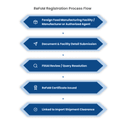
Figure 1
Steps typically involved:
- Submit facility details, product categories, and safety certifications
- Provide details of the Indian importer/authorized representative
- Respond to FSSAI queries or deficiency notices, if raised
- Receive the ReFoM certificate before shipments are processed
Validity and Renewal of ReFoM Registration India
Registration of a foreign food manufacturing facility is valid for a period of two years. The registration must be renewed by submitting Form 16 at least 30 days before the expiry date specified in the registration certificate.
Manufacturers should track expiry dates proactively, since lapsed registrations can halt shipments mid-transit, leading to storage costs, spoilage risks, and strained relationships with Indian buyers.
Any change in ownership, facility address, or product formulation during the validity period should be promptly updated with FSSAI to avoid discrepancies during customs verification or audits.
Compliance Checklist Table for Foreign Food Manufacturing Registration
The table below summarizes core compliance requirements overseas manufacturers should verify before exporting to India.
| Compliance Area | Requirement | Responsible Party |
| Foreign Food Manufacturing Registration | ReFoM certificate for notified categories | Foreign food manufacturer or Authorized agent |
| Import License | Valid FSSAI import license | Indian importer |
| Labelling | FSS labelling regulations compliance | Manufacturer/importer |
| Product Testing | Conformity with Indian safety standards | Manufacturer |
| Documentation | Health certificate, certificate of origin | Exporting authority |
Table 1
Common Compliance Challenges for Overseas Food Manufacturers
Many exporters face delays due to incomplete documentation, mismatched product categorization, or unfamiliarity with FSSAI’s evolving notifications on registration timelines and product scope.
Frequent issues include:
- Confusion over which product categories require ReFoM registration
- Delayed responses to FSSAI clarification queries
- Non-standard or missing sanitary certificates
- Labelling that doesn’t match Indian regulatory formats
- Lack of a responsive Indian regulatory representative
Working with an experienced regulatory consultant helps overseas manufacturers avoid these pitfalls and keeps shipments moving without customs holds.
Role of Regulatory Consultants in Simplifying Compliance
Regulatory consultants familiar with Indian food law bridge the gap between overseas manufacturing practices and FSSAI’s documentation, testing, and portal-based application expectations.
They assist with preparing accurate technical dossiers, translating certificates where needed, and liaising directly with FSSAI officials to resolve deficiency notices faster.
For first-time exporters, this guidance often shortens approval timelines significantly and reduces the likelihood of shipment rejection at Indian ports due to avoidable documentation errors.
Summary
- Overseas manufacturers exporting notified food categories to India need Foreign Food Manufacturing Registration (ReFoM) before shipment clearance.
- Food export compliance India starts at the manufacturing facility, not just at the port of entry.
- Food import regulations India covers licensing, labelling, testing, and certification requirements.
- A clear compliance checklist and Indian regulatory partner reduce delays and rejection risks.
Conclusion
Staying compliant is non-negotiable for global food businesses targeting India. Completing Foreign Food Manufacturing Registration early, along with meeting labelling, testing, and documentation norms, ensures smoother approvals and uninterrupted market access.
Partnering with experienced regulatory consultants like CliniExperts can further simplify this journey, helping overseas manufacturers navigate ReFoM registration, Documentation, and FSSAI compliance with greater speed and confidence.
Enquire Now
To enquire about our services please complete the form below and we will be in tough with you as soon as possible

Food Regulatory Services
- Consumer Product
- Compliance Services
- Licenses