Table of Content
How to Get FSSAI License for Proprietary Food Products in India

FSSAI license proprietary food approval is essential for businesses manufacturing or selling innovative food products that are not standardized under existing Indian food regulations.
Understanding Proprietary Food Registration India
Under FSSAI regulations, proprietary foods are products that do not have specific standards defined under existing food regulations but are manufactured or sold using only those ingredients and additives that are individually permitted under the regulations These products are prepared using approved ingredients but follow unique formulations developed by manufacturers.
Examples of proprietary foods include:
- Flavoured milk beverages with unique combinations
- Fusion sauces or dips
- Carbonated fruit-herbal drinks
- Snack bars combining nuts, seeds, chocolate, and dried fruits
- Ready-to-eat mixes with non-standard flavour blends
The process of proprietary food registration India ensures that such products remain safe for consumer consumption.
Importance of FSSAI License Proprietary Food Approval
Obtaining an FSSAI license proprietary food approval is mandatory before manufacturing, marketing, or distributing proprietary food products in India.
The license ensures compliance with food safety regulations and protects consumer health.
Key benefits include:
- Legal authorization to sell products
- Enhanced consumer trust
- Improved brand credibility
- Better regulatory compliance
- Reduced legal risks
Proper licensing also helps businesses expand into wider markets.
Food Business License India: Eligibility Requirements
A valid food business license India is mandatory for all food business operators involved in proprietary food manufacturing or sales.
Businesses requiring FSSAI licensing include:
- Food manufacturers
- Importers
- Repackers
- Online food sellers
- Retailers and distributors
Any product falling under proprietary food is mandated to obtain only a Central License.
Steps for Proprietary Food Registration India
The registration process follows a structured regulatory framework.
1. Product Formulation Review
Manufacturers must verify that all ingredients comply with FSSAI-approved ingredient lists and food additive regulations.
2. Document Preparation
Applicants must prepare technical and legal documents for submission.
3. Online FSSAI Application
Applications are filed through the FoSCoS portal under the relevant food category.
4. Regulatory Review and Approval
FSSAI authorities review the submitted documents and issue the food license after successful verification.
Table 1: Documents Required for FSSAI License Proprietary Food
| Document Type | Purpose |
| Business Registration | Verifies legal business entity |
| Product Ingredient List | Confirms formulation compliance |
| Manufacturing Details | Provides facility information |
| Identity and Address Proof | Validates applicant information |

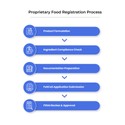
Figure 1
Labeling Requirements for Proprietary Food Products
FSSAI places strong emphasis on accurate product labeling to ensure transparency and consumer awareness.
Labels must include:
- Product name
- Ingredient details
- Nutritional information
- Manufacturing and expiry dates
- FSSAI license number
- Usage instructions
Incorrect labeling may result in rejection or regulatory penalties.
Common Challenges in Food Business License India
Businesses often encounter regulatory challenges during approval.
Common issues include:
- Use of non-approved ingredients
- Incorrect product classification
- Incomplete documentation
- Labeling non-compliance
- Delays in regulatory review
Professional regulatory support can simplify approvals and reduce compliance risks.
Best Practices for FSSAI Compliance
Businesses can improve approval efficiency by following structured compliance practices.
- Verify ingredient legality before formulation
- Maintain accurate technical documentation
- Ensure compliant product labeling
- Conduct internal quality checks
- Monitor regulatory updates regularly
These practices strengthen long-term food safety compliance.
Benefits of Proprietary Food Registration India
Obtaining regulatory approval provides several commercial advantages.
Business Advantages
- Legal market access
- Stronger customer confidence
- Improved product credibility
- Better retail acceptance
Consumer Advantages
- Safer food products
- Transparent ingredient information
- Improved quality assurance
Compliance contributes to both consumer safety and business growth.
Conclusion
- Proprietary foods require mandatory FSSAI approval
- Ingredient and label compliance are critical
- FoSCoS portal manages online applications
- Proper documentation reduces approval delays
- Regulatory compliance improves market credibility
In conclusion, FSSAI license proprietary food approval is essential for businesses introducing innovative food products in India, ensuring safety, legal compliance, and successful market entry.
Enquire Now
To enquire about our services please complete the form below and we will be in tough with you as soon as possible

Food Regulatory Services
- Consumer Product
- Compliance Services
- Licenses